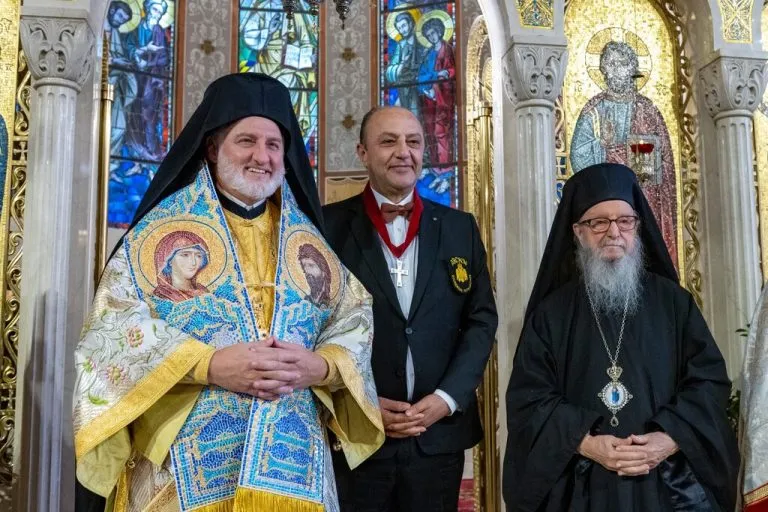



Bucharest, 15 July: On Sunday, 12 July, 300 years were completed since the body of the Prince of Wallachia, Constantin Brâncoveanu (1688-1714), was brought back to the country from the island of Halki, to the Church of Saint George the New in Bucharest. The Alexandrion Foundation commemorated, alongside the Romanian Orthodox Church, this historic event, held at the Church of Saint George the New, the last great foundation of Prince Constantin Brâncoveanu and the only one to have survived the centuries in the capital. In 1720, Princess Maria Brâncoveanu managed, after great efforts and after enduring suffering and obstacles, to bring back to the country the body of the martyr voivode, remaining to this day an example of unwavering faith, patience, tenacity and boundless love for her family and her people.
Academician Răzvan Theodorescu, executive president of the jury of the Constantin Brâncoveanu Awards Gala, organised by the Alexandrion Foundation, spoke about this important moment, following the thread of history, in an interview given to the programme Realitatea Spirituală: “Bringing the bodies of those who were martyred, a few years earlier, to Istanbul and laying them in a foundation, also a Brâncoveanu one, but not where they should have been, is a dramatic story. Brâncoveanu had prepared for his whole line, for his sons and daughters, a mausoleum in the pronaos at Hurez, where ‘the old line of my kin’ is painted, as the saying goes: the Brâncoveanus and the Cantacuzinos. It did not happen that way; the whole male side fell beneath the blade of the yataghan, on that day of Saint Mary in the year 1714 […] The date of the bringing and burial at Saint George the New of the bodies of Constantin Brâncoveanu and of some of his sons is also an exercise in historical psychology […] The people around the church of Saint George the New, which was not supposed to be a necropolis but became one, this church rebuilt by the Brâncoveanu family became the Brâncoveanu place of worship par excellence. Today we go there to lay down the offering of our piety.”
Like Prince Constantin Brâncoveanu, Princess Maria Brâncoveanu is an emblematic figure in the history of the Romanian people through her complete faith in God in the hardest moments, courage in extremely risky situations, integrity and total devotion to her family and her people. A wife and the mother of 11 children, Princess Marica endured, with an inner strength hard to match, the greatest suffering a person can go through: the killing of her husband and of her 4 sons, Constantin, Ștefan, Radu and Matei. Imprisoned, she refused to compromise with the murderers of her kin in order to be freed, but fought with all her might, overcoming extremely dangerous situations and using all her material resources, to bring the mortal remains of the martyred prince back to his country.
Of Princess Maria Brâncoveanu, Academician Răzvan Theodorescu says with conviction: “Yes, Maria Brâncoveanu deserves to become a saint of the Romanian nation.”
During the reign of Constantin Brâncoveanu, Princess Maria played a decisive role in the life and actions of the prince. She supported his cultural pursuits, concerning the printing of books, the founding of libraries, the building of churches and monuments, the encouragement of education and the helping of the poor.